ROOFBookable
Roof Inspection
An hour on your roof with a written report and photographs of every plane, so you know what you are dealing with before you spend anything.
$189 to $389Flat priced, no diagnostic fee
Roof inspection, repair and replacement, plus gutters, flashing, siding and storm damage insurance work.
An hour on your roof with a written report and photographs of every plane, so you know what you are dealing with before you spend anything.
$189 to $389Flat priced, no diagnostic fee
We find and fix roof leaks, from a cracked pipe boot to failed step flashing, and we cover an active leak around the clock.
$350 to $2,800After a $89 diagnostic, waived on approval
A full roof replacement, quoted after an on-site measurement and a materials selection rather than over the phone.
$9,500 to $28,000Quoted on site, free estimate
We document storm damage properly, meet your adjuster on the roof, and carry out the approved work. We do not negotiate the claim for you.
$1,200 to $32,000Quoted on site, free estimate
Seamless gutters formed on site to your rooflines, with downspouts sized and routed to take water away from the foundation.
$1,400 to $8,600Quoted on site, free estimate
Skylight replacement and the flashing details at chimneys, walls and valleys, which cause more leaks than shingles ever do.
$420 to $3,400After a $89 diagnostic, waived on approval
Siding, soffit and fascia repair and replacement, including the hidden rot behind a failed gutter and the intake ventilation your roof depends on.
$480 to $18,000Charged hourly
The Triangle sits far enough inland to avoid the worst of the coastal wind, and close enough to get the remains of every hurricane that tracks up the eastern seaboard. Add summer hail and the long UV load of a North Carolina August, and asphalt shingle roofs here age faster than the warranty on the box suggests.
Most roofs we work on are architectural asphalt shingle, which is what the great majority of Triangle housing stock carries. We also work on metal, on low-slope membrane over porches and additions, and on the flashing and sheet metal details that cause more leaks than shingles ever do.
Almost every roofing job starts the same way: somebody looks at the roof properly and writes down what they find.
That matters more here than in most trades, because roof problems are usually invisible from the ground and because the difference between a repair and a replacement is thousands of pounds. A roof inspection is bookable, flat-priced and takes about an hour, and it produces a written report with photographs of every plane.
If you already know you have a leak, book a roof repair instead. An active leak is emergency-eligible and we dispatch around the clock for it.
Three different routes, and which one you are on is usually decided by the inspection.
Repair is right when the roof is sound and a specific detail has failed: a cracked pipe boot, a lifted ridge cap, step flashing that was never installed properly at a chimney. Most Triangle leaks are flashing rather than field shingle.
Replacement is right when the shingles are at the end of their life, when granule loss is general rather than local, or when repeated repairs have stopped being economic. It is quoted after an on-site measurement and a materials selection, never over the phone, and it is financing eligible.
An insurance claim is a different process again, and it is the one most people get wrong. If your roof was damaged by a storm rather than by age, see storm damage and insurance claims, which sets out the adjuster process, what documentation we supply, and where our role stops.
We do not negotiate with your insurer on your behalf. We are not public adjusters and we are not licensed to act for you in a claim. We supply the documentation, we attend the inspection, and we answer technical questions about the damage. The claim itself stays between you and your insurer.
We do not remove trees, including the one that landed on your roof. Call a certified arborist first, and us second; we will tarp the opening to stop further water getting in while you arrange the removal.
We do not disturb suspected asbestos, which turns up in older roof felt and in some cement siding. If we find it we stop and refer you to an abatement contractor.
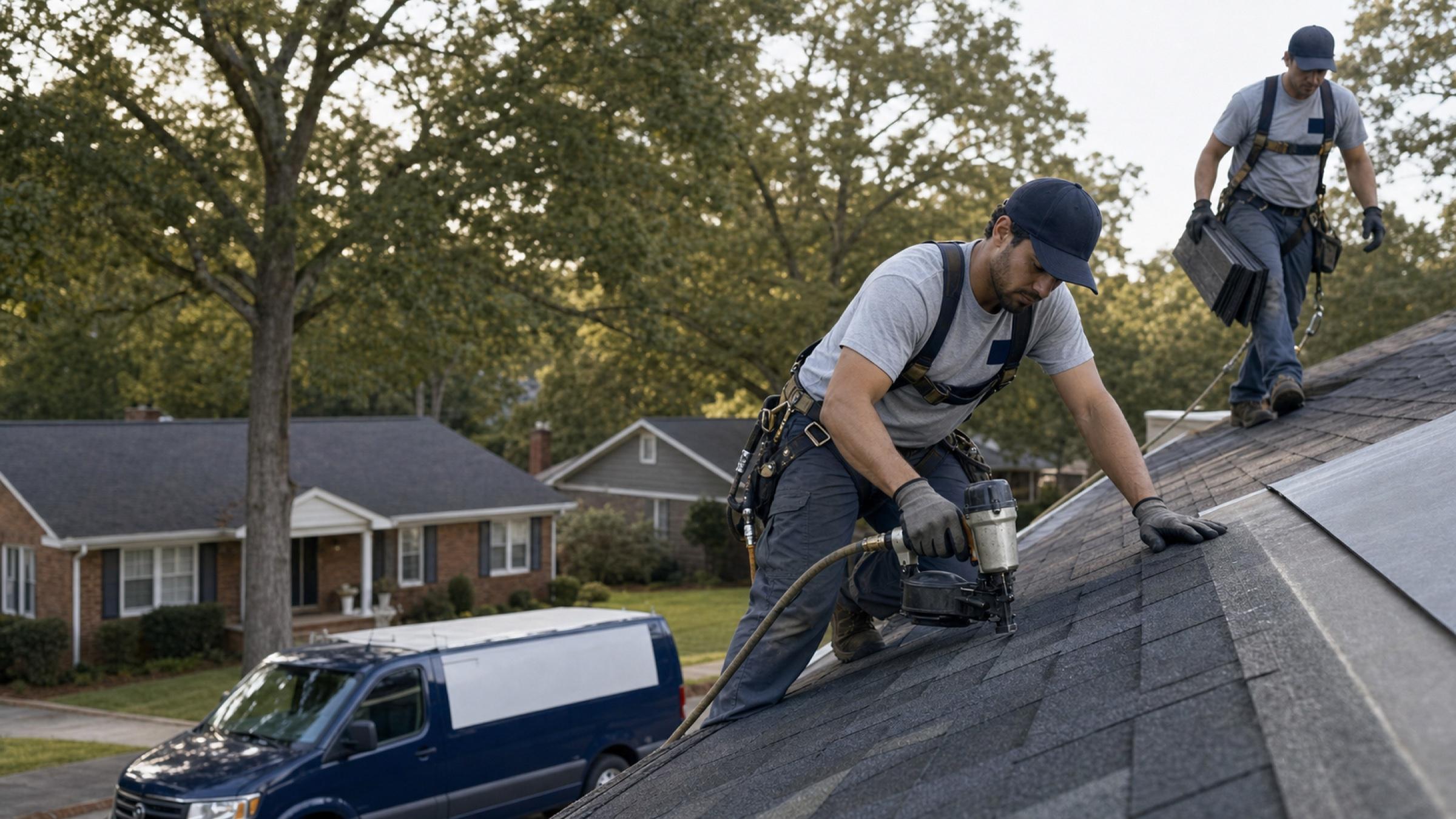
Every crew works harnessed and anchored, on every roof, including the low ones. That is not negotiable and it is occasionally the reason a job takes a day longer than a competitor quoted.
Roofing work is loud, it drops debris, and it needs the driveway. We tell you which days are the noisy ones, we sheet the beds and the AC condenser before we start, and we run a magnet over the lawn and the drive at the end of every day rather than only at the end of the job.